Damp Wall Treatment: Paint, Render or a Wall Drying Device?
August 13, 2026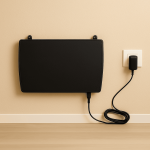
Wall Drying Device: How to Choose the Right One
September 7, 2026Damp Proofing Without Injection: What Are the Options?
Damp proofing without injection remains entirely possible. However, the available methods differ a lot. And none of them replaces a correct diagnosis. So here is what exists beyond resin injection, what each option does to the masonry, and when wall drying technology answers the need.
Why look for damp proofing without injection
Resin injection remains the most common proposal. The principle sounds simple. First, a contractor drills a row of holes at the base of the wall. Then he injects a water-repellent product, which should form a continuous horizontal barrier.
However, several situations push owners towards damp proofing without injection.
First, the nature of the wall. Older masonry mixes stones of different sizes, bricks and lime mortar. Sometimes voids run through it as well. As a result, the product spreads unevenly. Yet the outcome depends precisely on that regularity, which older buildings rarely offer.
Second, the permanent change. Once the holes go in, the wall changes for good. On a period property, therefore, this raises a real question.
Third, a simpler reason. Some owners refuse any drilling in a load-bearing wall. Others live on site and want to avoid building work.
These reasons hold up. Still, they change nothing about one essential point. Any treatment must address the cause, that is to say the water rising from the ground.
First, confirm that the damp really rises from the ground
Many people skip this step. Yet it decides everything else. Indeed, three types of damp leave similar marks. And they call for completely different work.
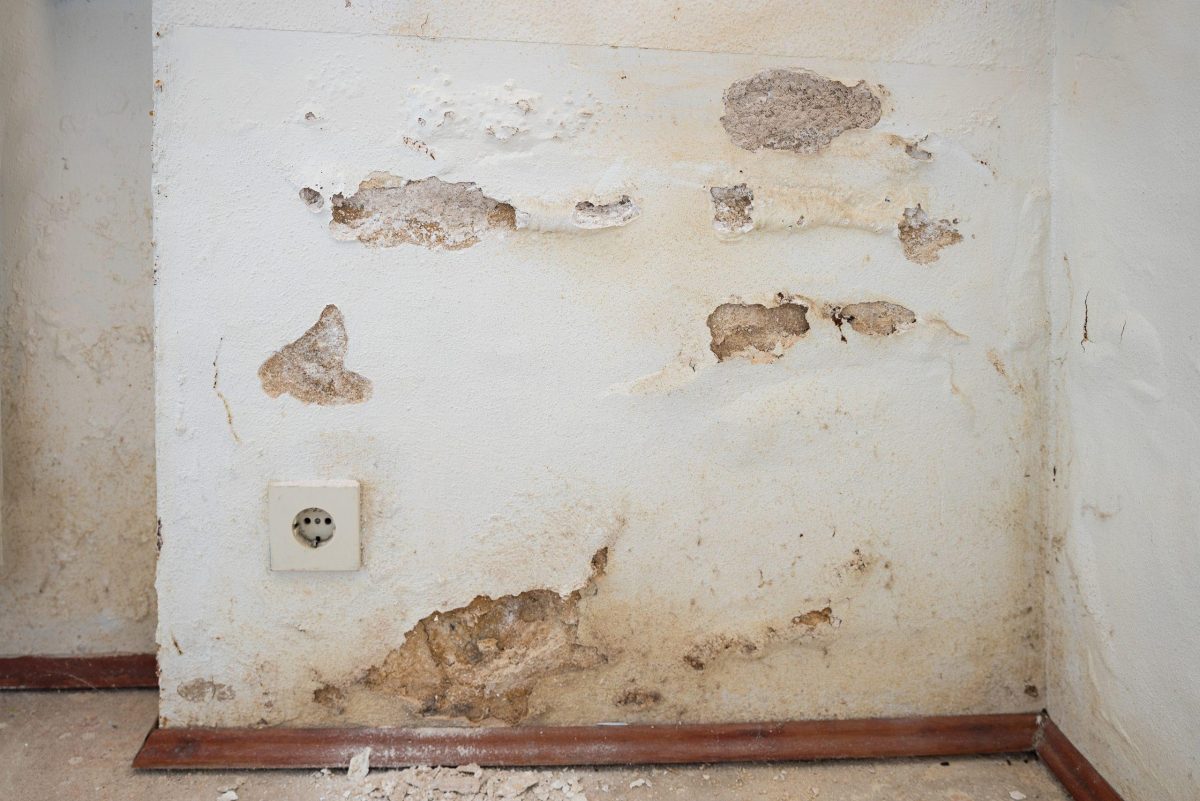
Rising damp draws a continuous band along the base of the wall. Its height stays fairly even. Moreover, it shows on both faces of the same wall, inside and outside. Its upper edge looks blurred and slightly wavy. In addition, it changes slowly, over months, with no link to recent rain. White powdery deposits often appear too. Plaster crumbles and paint blisters low down.
By contrast, an isolated sharp patch means something else. It appears quickly, high up or around an opening. Therefore it suggests penetrating damp: a roof defect, a failed window seal, a crack or a leaking pipe.
Condensation forms a third case. It leaves black mould in corners, on cold surfaces or behind furniture. A musty smell settles in. In short, the indoor air holds too much vapour and the ventilation cannot cope.
Sometimes all three occur together. However, a rising damp treatment does nothing for the other two. Our rising damp page sets out every sign in detail.
Damp proofing without injection: the four options
Perimeter drainage
Here, a contractor digs a trench at the base of the footings. Then he lays a drain, which carries water away from the building. In practice, this reduces the water around the walls. By contrast, it does nothing about capillarity itself.
So it suits ground that holds water. However, it requires excavation all around, and therefore outside access. On its own, moreover, it rarely helps once the masonry is already saturated.
A physical damp proof course
This time, a saw opens the wall horizontally, section by section. A waterproof membrane then slides into the slot. As a result, the barrier becomes physical and lasting.
There is certainly no injection here. Nevertheless, the work stays heavy and touches a load-bearing element. It also assumes regular masonry and full access along every wall. On irregular older buildings, therefore, surveyors often rule it out for the same reasons as injection.
Renovating plasters
These macroporous plasters let vapour escape. At the same time, they hold salts inside their thickness. So the wall looks decent again. And visible damage returns later.
However, they treat the symptom rather than the cause. Water keeps rising. In other words, the plaster eventually saturates. It therefore helps alongside a real treatment, never instead of one.
Wall drying technology
This approach changes the logic entirely. It acts on how the water behaves, not on the structure.
Indeed, water molecules carry a positive and a negative pole. That polarity helps them climb through the capillaries. Yet a wall drying device emits a low-frequency signal that acts on it. Consequently, the water moves back down, and the wall dries gradually.
So it is the only one of the four options that avoids excavation, sawing, drilling and chemicals at once. In short, it delivers damp proofing without injection and without a building site.
Damp proofing without injection: what wall drying technology changes
The masonry stays intact
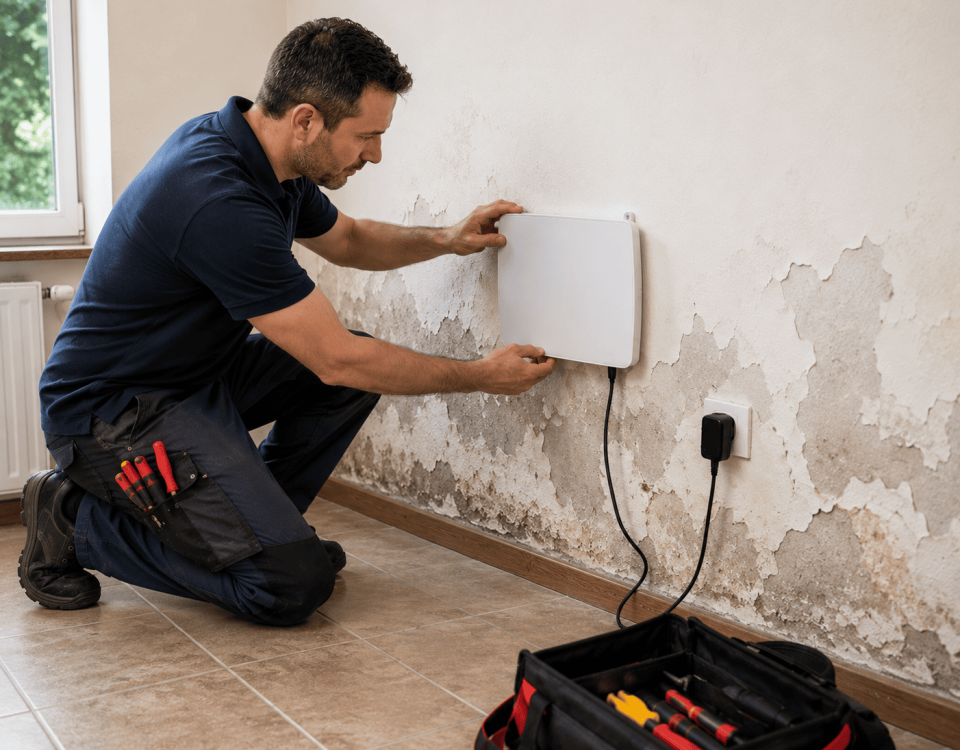
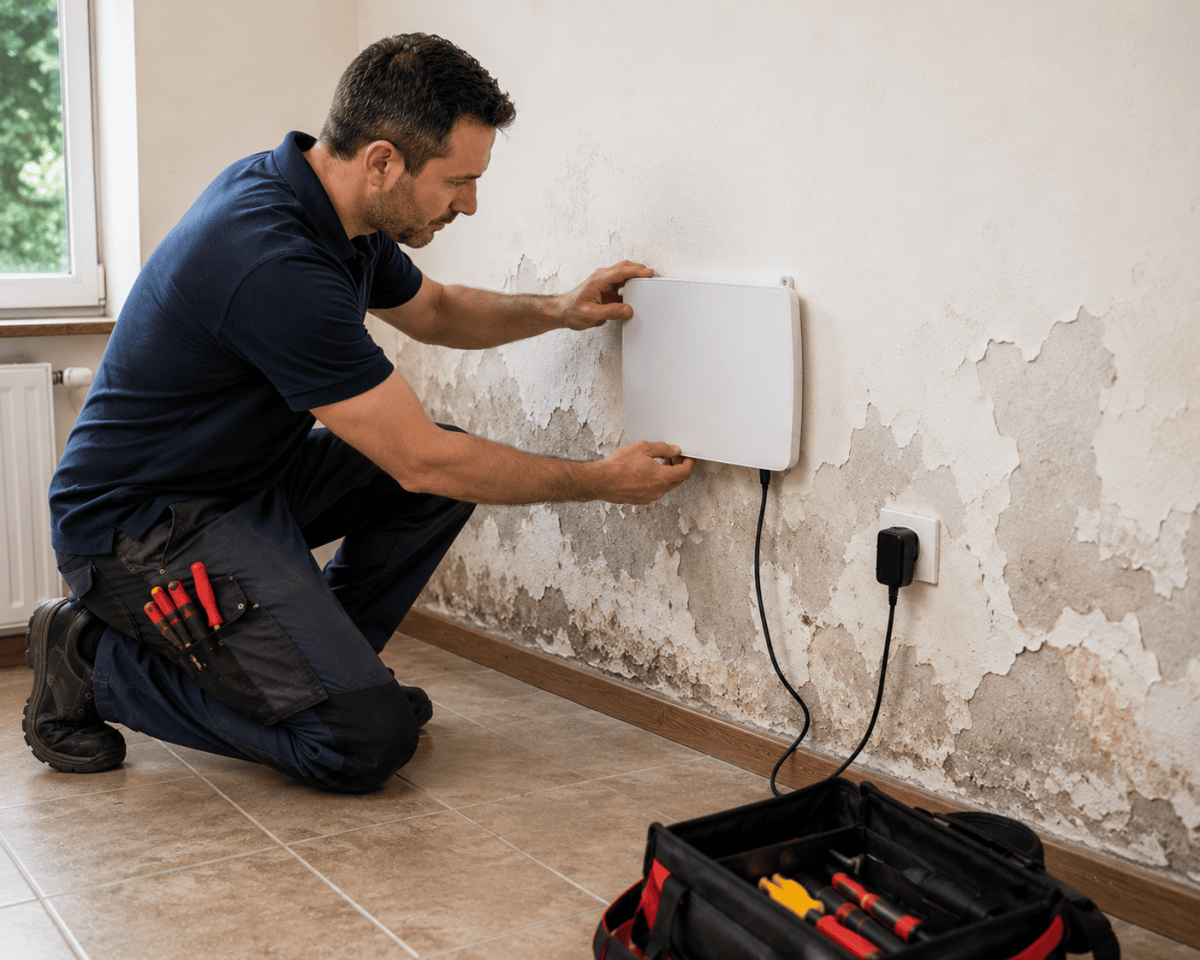
The unit fixes at the base of a damp load-bearing wall. No holes, no product. On stone or old brick, therefore, this difference matters enormously. In short, you keep the fabric of the building untouched.
The work stays reversible
You fit a unit, and later you remove it. The wall keeps no trace. Consequently, this reversibility counts a great deal for a property heading for sale or subject to heritage constraints.
Installation needs no building work
At Humidistop, the technology exists in two versions.
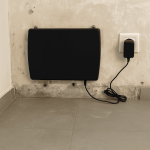
The ATE units use electromagnetism. They plug into an earthed socket. Their consumption reaches about 0.75 W, so roughly €15 of electricity a year. Moreover, they need no maintenance at all.
The ATG units use the Earth’s natural magnetic field. Therefore they run with no electricity, no battery and no maintenance.
In practice, we recommend the electromagnetic version first. It works from the moment you plug it in and produces a constant field. By contrast, where no permanent supply exists, the geomagnetic version takes over.
The unit fits at the base of a damp load-bearing wall, ideally at the centre of the treated area. It needs a flat surface and direct contact with the masonry. Never dry lining. Finally, the model sets the radius covered: 15 metres in diameter for the ATE LC15, 30 metres for the ATE LC30, and 60 metres for the ATE MAX.
The limits you should know first
No method of damp proofing without injection escapes honesty about its limits.
First, drying moves slowly. When you follow our guidance, you generally see improvement between 18 and 24 months. In other words, nobody sees a result the following week. Therefore any promise of an immediate result deserves suspicion.
Second, the duration varies. It depends on the initial moisture level, on wall thickness, and on how freely the wall evaporates.
Furthermore, the scope stays narrow, and we say so plainly. These units treat rising damp. By contrast, they do not treat water penetration, flooding or surface mould.
Finally, an undersized unit covers less. So walls beyond the radius of action receive no treatment at all.
Simple steps that speed up drying
A few light jobs help a great deal, whatever method you choose.
First, strip sealed finishes low down. That single step helps most. Indeed, cement render, impermeable paint or bonded tiling stop the water evaporating. Then it stays trapped and climbs higher.
Next, remove dry lining across the treated areas. In this way, you restore air movement at the wall surface.
Moreover, fix outside water sources. A broken downpipe, ground sloping towards the façade or a blocked gully keep feeding the soil. As a result, they cancel part of the expected benefit.
Finally, keep decent ventilation. It supports evaporation, although it never replaces the treatment.
As for plaster and paint, redecorate once the wall reaches a stable moisture level. Never during the drying phase.
Frequently asked questions
Is damp proofing without injection genuinely possible?
Yes. Indeed, wall drying technology avoids drilling, sawing and excavation. The unit fixes to the wall and runs continuously, with no product inside the masonry.
Is anti-damp paint enough?
No. On the contrary, paint on a damp wall blocks evaporation. Therefore it pushes the problem higher up the wall. In short, it treats the appearance, never the cause.
Must I strip the plaster before fitting a unit?
Not necessarily. However, removing sealed finishes and dry lining helps evaporation. As a result, it shortens the drying time noticeably.
How long before I see a change?
Generally between 18 and 24 months, provided you follow our installation guidance. Then the duration varies with the initial moisture level and the nature of the walls.
Does damp proofing without injection suit a stone house?
Yes, and that is exactly where the absence of drilling counts most. Indeed, old masonry accepts even product diffusion poorly. The model then depends on the distance to cover and on the presence of an earthed socket.
In short
For damp proofing without injection, four options exist: perimeter drainage, a physical damp proof course, renovating plasters and wall drying technology. The first three impose building work, or address the cause only partly. By contrast, wall drying technology leaves the masonry intact and stays fully reversible.
So, for damp proofing without injection, find the right model in the Humidistop shop. And if you doubt the origin of the damp, send a few photographs of your walls through the contact form. Our experts reply free of charge, with no site visit.